

Dr. Sue Ellen Richardson explains the recently published CHOICE trial which included delving into combination CPAP and OAT therapies. The trial showed that success depends not only on the therapy itself, but on how well patients are educated, engaged, and supported.
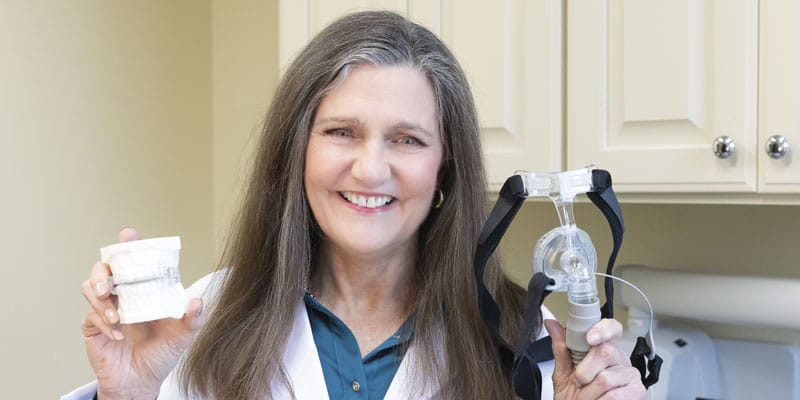
by Sue Ellen Richardson, DDS
Introduction: A Shared Challenge
Obstructive sleep apnea (OSA) remains one of the most prevalent and undertreated chronic health conditions worldwide. Its consequences — daytime sleepiness, impaired cognitive function, cardiovascular risk, and diminished quality of life — are well known to both physicians and dentists. Although continuous positive airway pressure (CPAP) has long been recognized as the standard of care for reducing respiratory indices, oral appliance therapy (OAT), delivered through mandibular advancement splints (MAS), has demonstrated substantial benefit for many patients by improving symptoms, quality of life, and adherence.
Traditionally, the care pathway has positioned CPAP as the first therapy offered, while OAT was often reserved for patients who could not tolerate PAP therapy. The recently published CHOICE Trial (2024) challenges this long-standing sequencing. It provides compelling evidence that patients may achieve the best outcomes when CPAP and OAT are not viewed as competing therapies but as complementary tools that can be used individually, interchangeably, or in combination. This represents a shift from an either/or approach to a both/and model of OSA care — one that highlights the power of interprofessional collaboration.
The CHOICE Trial at a Glance
The CHOICE study was a multicenter, double- randomized clinical trial conducted across three Canadian universities, an 11-year ‘labor of love’. The trial recruited 81 treatment-naïve adults with moderate to severe OSA (BMI <35). The trial included 18 months of participation for each patient, with 15 total visits. After initial titration for both CPAP and MAS, participants completed a crossover phase where each therapy was trialed for one month. Importantly, patients were then provided with their own individualized efficacy results for both treatments. This disclosure allowed participants to understand how well each therapy worked for them personally before entering a 6-month “real-world” observational phase, in which they could freely choose between CPAP, MAS, or both on any given night.
The study’s objectives were threefold: to evaluate usage patterns when patients were empowered with choice, to compare the effectiveness and adherence of CPAP and MAS in real-world conditions, and to assess the impact of these treatments on clinical outcomes including blood pressure.
Key Findings: Efficacy and Adherence
Efficacy
As expected, CPAP was the most effective at reducing respiratory events, lowering the respiratory event index (REI) from a baseline of ~22 events/hour to ~2.2 events/hour. MAS therapy reduced REI to approximately 12 events/hour. Despite this difference in physiologic efficacy, both therapies produced substantial and nearly equivalent improvements in patient-centered outcomes, including daytime sleepiness (Epworth Sleepiness Scale), fatigue (Chalder Fatigue Questionnaire), and daily functioning (FOSQ-10, SF-36).
Adherence
Adherence patterns yielded some of the most striking findings. Patients using MAS monotherapy demonstrated higher average nightly use compared with CPAP monotherapy (6.0 vs. 5.3 hours/night). When given the opportunity to choose between treatments, participants not only used therapy for more hours per night but also on more nights per week. This flexibility translated into a substantial adherence benefit: 84% of participants achieved ≥4 hours of use per night, a threshold often cited as a key clinical benchmark. In other words, allowing patients to select their preferred therapy markedly improved adherence across the board.
Usage Patterns
Patient preferences over the 6-month observational phase revealed that no single therapy met the needs of all patients. Approximately 20% relied exclusively on CPAP, 9% used only MAS, and a majority — 55% — alternated between the two. This alternation occurred both across nights and, in some cases, within the same night. Preferences shifted during the observation phase, and many participants who predicted they would favor one therapy ultimately chose the other or alternated between both. Only 8% were partially adherent (1–4 hours/night) and 8% were non-adherent (<1 hour/night).
Blood Pressure Outcomes
Participants, particularly those with hypertension, experienced significant reductions in both systolic and diastolic blood pressure. Notably, alternating therapy produced greater reductions in blood pressure than CPAP alone, underscoring the value of sustained adherence made possible by multimodal care.
Side Effects
Adverse effects were documented for both therapies — mask discomfort and air leaks with CPAP, jaw soreness, and chewing difficulty with MAS. However, symptoms diminished over time, and patients who alternated therapies often found relief by switching between devices, enabling them to maintain adherence.
Together, these results highlight that multimodal therapy preserves the physiologic benefits of CPAP while incorporating the adherence advantage of MAS.
Clinical Translation: CHOICE in Practice
The CHOICE Trial has important implications for clinical practice in both medicine and dentistry. Its findings highlight that long-term success depends not only on the therapy itself, but on how well patients are educated, engaged, and supported in their choices. By disclosing personalized efficacy results and offering both CPAP and OAT, clinicians can create a care environment in which patients are engaged and active participants in their therapy.
Patients valued this flexibility so highly that many were willing to invest in both therapies when given the opportunity. Their willingness to pay for dual treatment options reinforces how much they perceived the benefit of choice in supporting comfort, long-term use, and better health outcomes. This insight points directly to several practical strategies for implementation:
Practical strategies include:
- Providing individualized efficacy data to patients from each treatment to support informed decision-making and treatment ownership.
- Encouraging flexibility by presenting multimodal regimens as viable, evidence-based treatment options.
- Measuring success with broad outcomes, including daytime function, fatigue, and blood pressure — not AHI alone.
- Supporting adherence through choice, allowing patients to alternate therapies as needed for comfort and sustainability. Encourage the patient to use a wearable monitor to maintain motivation towards treatment.
Why This Matters for Dental Sleep Medicine
For dental sleep professionals, the CHOICE Trial offers more than validation of oral appliance therapy — it provides a powerful opportunity to strengthen collaboration with physicians. The study demonstrates that OAT is not simply a fallback option but a partner therapy that complements CPAP.
Three key messages emerge for dentists engaging medical colleagues:
- Position OAT as a partner therapy. OAT enhances overall adherence when used alongside CPAP, ensuring patients stay in treatment longer.
- Highlight adherence. Physicians already recognize CPAP’s efficacy; CHOICE shows that the addition of OAT leads to more consistent use and better patient outcomes.
- Focus on shared goals. Both professions aim to reduce symptoms, maintain adherence, and improve health. CHOICE confirms that these outcomes are most achievable when therapies are combined.
By presenting OAT in this way, dentists can build bridges rather than silos, reinforcing their role as essential partners in comprehensive OSA management.
Conclusion: Stronger Together
The CHOICE Trial reframes OSA care from a binary decision between CPAP or MAS to a collaborative model where patients benefit from both/and. Alternating CPAP and OAT is not only feasible but beneficial, enhancing adherence, supporting patient preferences, and improving outcomes — including meaningful reductions in blood pressure.
For dentists, this evidence represents a call to collaboration. By using CHOICE as a foundation for dialogue, dental sleep professionals can approach physicians with data that validates oral appliance therapy, not as competition, but as a tool that strengthens patient success.
Ultimately, everyone benefits. Physicians gain partners who help their patients stay adherent. Dentists gain credibility and deeper interprofessional connections. Patients gain flexibility, comfort, and improved long-term health.
The message is clear: the future of OSA care is not either/or, but both/and. Together, physicians and dentists can offer patients the choice — and the adherence — they deserve.
Want to Dive Deeper?
For a more comprehensive clinical walkthrough of this groundbreaking research, watch Dr. Nelly Huynh’s 2025 AADSM Annual Meeting presentation, where she brings these concepts to life with striking visuals and practical case examples.
And don’t miss the European Respiratory Journal Podcast (April 2025): Continuous Positive Airway Pressure and Mandibular Advancement Splints, featuring Dr. Fernanda Almeida, who shares her expert insights.
For more insights into treating patients with a combination of CPAP and OAT therapies, read “Combination Therapy: by Ronald S. Prehn, ThM, DDS, at https://dentalsleeppractice.com/combination-therapy-by-ronald-s-prehn-thm-dds/.
- Hamoda MM, Huynh N, Ayas NT, Rompré P, Bansback N, Masse JF, Arcache P, Lavigne G, Series F, Fleetham JA, Almeida FR. Continuous positive airway pressure and mandibular advancement splints: the CHOICE multicentre, open-label randomised clinical trial. Eur Respir J. 2025 Apr 3;65(4):2401100. doi: 10.1183/13993003.01100-2024. PMID: 39638418; PMCID: PMC11965959.