

Dr. Jerry Hu’s good outcomes with Panthera Dental mandibular advancement devices has led to his airway-centric focus on better sleep and daily function.
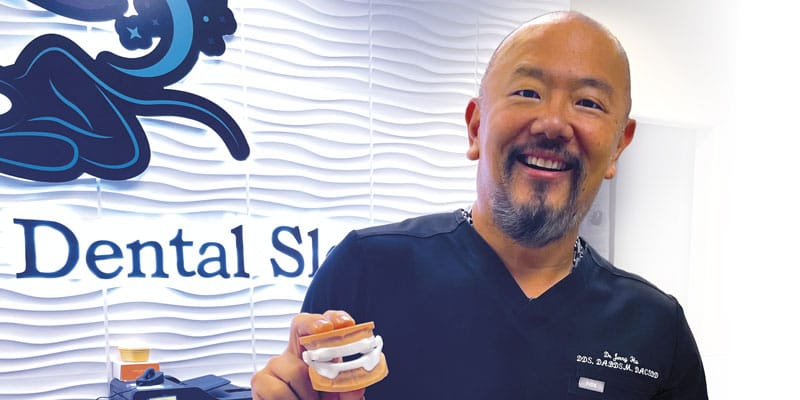
Dentists who practice airway-centric dentistry change more than smiles. They change sleep and daily function. That is the path Dr. Jerry Hu followed. He first met dental sleep medicine as a patient who could not tolerate CPAP.
Oral appliance therapy helped him regain energy, lose more than 100 pounds, and earn a black belt in karate after 40. He later became a triple-boarded sleep dentist who says it plainly: “Airway trumps everything.” That shift now guides his clinical decisions and teachings on dependable oral appliance therapy.
His view was shaped by family history. He remembers gasping for air, acid reflux, and restless sleep that once caused little concern. With hindsight, he connects those signs to broader systemic risk. Given how many adults live with undiagnosed or untreated obstructive sleep apnea, the dental chair is a logical place to screen and guide care. Airway-first thinking is both practical and ethical.
From Cosmetics to Airway-First
Early in his career, Dr. Hu focused on full-mouth rehabilitation and esthetics. Over time, he saw a pattern. Restorations that looked excellent at delivery did not always do well at night. Snoring, apneas, and arousal-driven clenching put load on teeth and implants that they were never designed to carry. If sleep-disordered breathing is not managed, dentistry will be asked to endure physiology it cannot overcome.
Screening moved from optional to standard, especially before complex restorative or implant plans. Health histories flag snoring, witnessed apneas, acid reflux, morning headaches, nocturia, and daytime sleepiness. Exams record tongue size and scalloping, Mallampati class, wear facets, and abfractions. When risk is present, testing proceeds through a physician. In his practice, an oral appliance always follows a diagnosis, not the other way around.
He also reframed success; a lower index means little if oxygen saturation remains low. His goals are steady breathing and fewer arousals. When those improve, patients report energetic mornings, fewer headaches, and less depression and mood swings. Treat the airway, steady the breathing, then let physiology do its work.
Bruxism connected the old and new parts of his practice. The literature classifies sleep bruxism as a sleep-related movement disorder that often clusters around respiratory events and arousals. In many patients, parafunction reflects airway stress, not a primary dental problem. A flat-plane bruxism night guard can ignore the airway causes of clenching and, in some patients, make the airway more likely to collapse during sleep. Dr. Hu screens, phenotypes, and treats in collaboration with medicine so device choice, jaw position, and physiology support the same outcome.
The Case that Changed His Course
“Ignore the airway, and physics will find you.” That is how Dr. Hu describes the day a patient walked in and “opened her hand” to reveal half an implant fixture with bone and soft tissue attached. “If I gave you ten years,” he tells colleagues, “you could not break an implant in half with your bare hands.” The case had followed standard steps, including grafting, healing, placement, and osseointegration.
What he had not done was assess through an airway lens. Pre-op photos later showed abfractions and fractures that signaled heavy parafunction. He had not scored a Mallampati, assessed tongue volume, or screened for snoring, acid reflux, or morning headaches.
Eighteen months later, the implant failed. His analysis was direct. During sleep, respiratory events trigger arousals. The autonomic surge that follows can drive strong jaw activity. Occlusion that looks fine when the patient is awake does not describe what the system endures at two in the morning under hypoxic stress. Over months, off-axis loading and shear add up where articulating paper cannot measure them.
On the AAID (American Academy of Implant Dentistry) stage, he challenged the reflex to “protect the dentistry” with generic flat-plane splints. “Some splints can worsen the airway,” he said. A night guard that occupies vertical without regard to mandibular posture, nasal airflow, and collapsibility can make breathing worse in susceptible patients. His message to implant and esthetic colleagues is consistent: screen for sleep, phenotype the patient, and involve a physician before major restorative work.
Method and Coaching
Good outcomes start with a careful beginning. Dr. Hu spends time capturing a therapeutic start position that respects joints, muscles, and airway, then validates when indicated with tools such as jaw tracking, surface electromyogram (EMG), or cone beam computed tomo-
graphy (CBCT). Numbers guide judgment; the patient provides the context.
A physician establishes the diagnosis. Titration proceeds stepwise. Coaching covers sleep hygiene, nutrition, activity, and stress regulation. Two stories illustrate the approach.
“One patient weighed over 400 pounds, was jobless from nodding off during the day, and unable to climb a single flight of stairs. I shared my own before-and-after photos to encourage him. Months later, he’d lost about 160 pounds — and eventually more than 200 — sent me a video of himself taking the stairs, and told us he’d been promoted at work.”
“Another, a Department of Labor veteran, was a former nuclear test-site worker with severe breathing and oxygen problems, and his wife was very worried. His nighttime oxygen sat around 81%, which I explained would trigger a crash-cart response in a hospital. After titration with an oral appliance, his AHI reached 0.0 and REM rose above 25%. His wife said ‘I’m telling you, I don’t know what it is. It’s like a magic thing you put in his mouth. But he is night and day better.’ His cardiologist now takes the dental treatment seriously. “
Oral appliances do not replace CPAP. They offer a path for patients who cannot or will not use PAP when delivered within a diagnosis- driven, titration-guided plan.
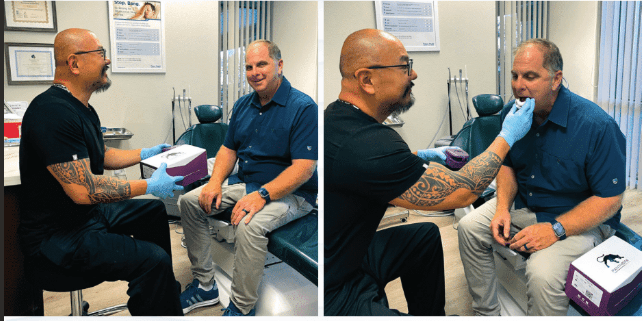
Adaptation takes time. Medicare’s 90-day window before efficacy testing matches physiology. Patients leave their appliance delivery appointment with a checklist for cleaning, morning occlusal settling, side-sleeping, alcohol timing, bedroom temperature, and nasal care. Small details add up. Team members reinforce the plan in clear language (American Dental Association, 2017).
Technology that Supports the Approach
Airway-first care benefits from a partner that is consistent, reliable, and fast. Dr. Hu works with Panthera Dental for four reasons: BioMatch simplifies the ordering and appliance design process, drop-in fit at delivery, 8-day manufacturing, and a 360 Warranty.
BioMatch. A single step workflow ordering and design process that allows a clinician to order and upload patient files directly from the intraoral scanner, for reliable, fast delivery of a drop-in fit, patient-matched appliance.
Drop-in fit and materials. Appliances seat cleanly with no soft-tissue contact, ample tongue space, and a low profile that supports lip seal and nasal breathing. Automated production and a proprietary polishing process create a smooth feel. Devices are metal-free, printed from a
medical-grade Type 12 PA2200 nylon that is light, durable, and biocompatible. As Dr. Hu notes, “You get a good scan and boom, it’s there.”
Speed and assurance. Panthera Sleep’s 8-day manufacturing keeps cases moving, especially when year-end schedules tighten. The 360 Warranty offers three years of coverage. As Dr. Hu puts it, “we have a wonderful warranty. Panthera Sleep is so confident in the product that they can give you this warranty.” That promise reinforces both perceived and real value, which helps patients commit to nightly use.
Devices that Match the Moment
Dr. Hu relies on two mandibular advancement devices from Panthera Sleep because they fit his goals: protect joints and teeth, support the airway, and keep visits focused on coaching not adjustments.
Panthera Classic. A E0486 medicare-reimbursed low-profile device in Type 12 PA2200 nylon. Minimal tooth contact and ample tongue space support comfort and lip seal. The 3.0 rod system offers a broad range and holds position.
Panthera X3. A dorsal pathway with fins for guidance and clip-on advancement modules for small changes without tools. Notches allow for elastics to promote mouth closure and nasal breathing in open-mouth sleepers. Also produced in Type 12 PA2200 nylon.
Both devices can be designed with BioMatch, produced in an automated environment with rigorous quality checks, manufactured in 8 days, and covered by the 360 Warranty. Selection follows phenotype and goals — Panthera Classic when rod-based traction and minimal soft-tissue contact serve the plan. Panthera X3 when a dorsal pathway, clip-on titration, and elastics will reduce arousal-driven mouth opening. In both paths, the aim is the same: restore oxygen, reduce arousals, and protect the dentistry by protecting the airway.
Takeaways
- Screen before planning and coordinate testing with a physician when risk appears.
- Plan restorations through a sleep lens; bruxism often reflects airway stress.
- Match devices to phenotype, and collaborate on titration targets.
- Standardize digital intake with BioMatch to reduce handoffs and speed delivery.
- Track oxygen saturation and arousals alongside AHI; set expectations for a 90-day adaptation window.
- Document like a medical device provider when billing medical insurance, including E0486 where applicable.
BioMatch from Panthera Dental streamlines ordering of appliances, while strengthening partnerships between dentists and sleep physicians. Read more about it here: https://dentalsleeppractice.com/industry-news/panthera-dental-unveils-biomatchtm-a-single-step-ordering-and-appliance-design-system-for-dental-sleep-apnea-therapy/.